
Commonwealth Kabaddi Championship 2026: India's Three Wins in a Row, and the Missing Iran Hidden Behind the 'Commonwealth' Noise
प्रश्न: कॉमनवेल्थ कबड्डी चैंपियनशिप 2026 में भारत का प्रदर्शन कैसा रहा है? उत्तर: भारतीय पुरुष टीम तीन मैचों में अपराजित है — इंग्लैंड को 46-26, युगांडा को 44-30 और मलेशिया को 37-23 से हराया। तीन मैचों में 127 अंक बनाए, 79 खोए। कप्तान सुरजीत सिंह हैं। चौथे दिन नाइजीरिया से मुकाबला है, जिसे तंजानिया (66-17) और इंग्लैंड (68-18) से भारी हार मिली है। मुख्य विश्लेषण: भारत का बचाव मज़बूत है (इंग्लैंड ने नाइजीरिया पर 68 बनाए, भारत पर सिर्फ़ 26), लेकिन हर मैच में 23-30 अंक खोना चिंता का विषय है। सबसे बड़ा तथ्य यह है कि ईरान — भारत का असली प्रतिद्वंद्वी — टूर्नामेंट में नहीं है, इसलिए तीन जीत वैश्विक वर्चस्व का प्रमाण नहीं हैं। मैदान तीन स्तरीय है: भारत > इंग्लैंड/तंजानिया/मलेशिया/युगांडा >> नाइजीरिया। सीमाएँ: खिलाड़ी-वार रेड/टैकल आँकड़े उपलब्ध नहीं; कप्तान की भूमिका (रेडर/डिफेंडर) स्पष्ट नहीं; स्टैंडर्ड बनाम सर्कल स्टाइल की पुष्टि नहीं; स्पॉन्सरशिप और प्रसारण अधिकारों का कोई डेटा नहीं। यह आयोजन कॉमनवेल्थ गेम्स का हिस्सा नहीं है — 'कॉमनवेल्थ' केवल ब्रांडिंग है, दर्जा नहीं।
India's men's kabaddi team is unbeaten at the Commonwealth Kabaddi Championship 2026 — three matches, three wins. England were beaten 46-26, Uganda 44-30 and Malaysia 37-23. On Day 4 India face Nigeria, who have so far been crushed by Tanzania (17-66) and England (18-68). On paper it is a formality. But read the scorelines closely and three things surface: India's defence is genuinely strong, India's attack is 'adequate' rather than 'spectacular', and — most importantly — the one team that could actually challenge India is not in this field at all.
First, the rules, because the scores are built from them
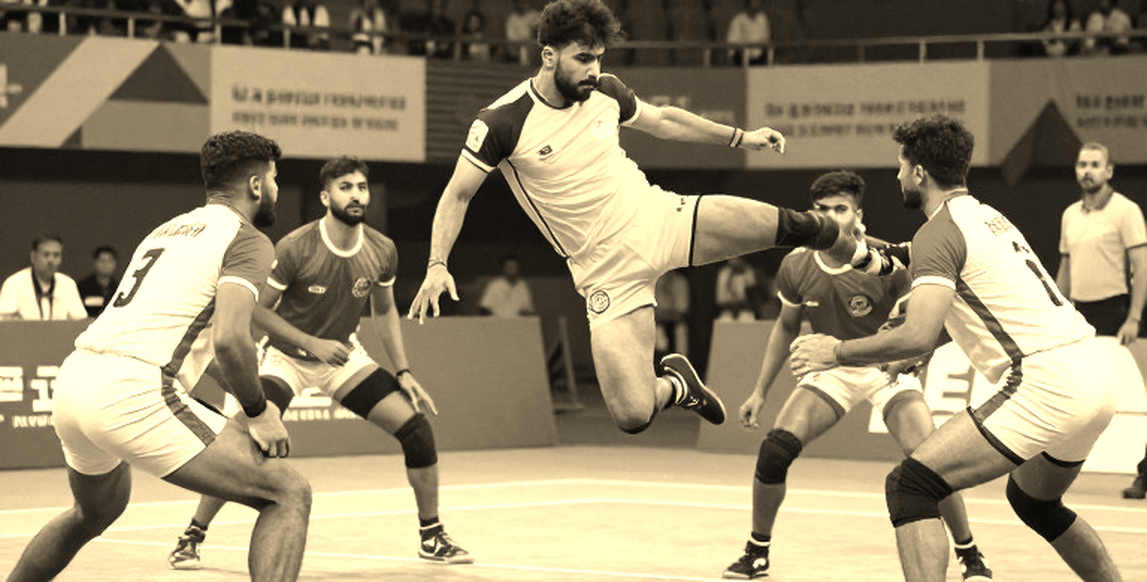
In kabaddi every point is tied to a specific rule. The raider crosses into the opponent's half and must touch a defender and return safely within 30 seconds to score — and throughout the raid he must chant 'Kabaddi... Kabaddi' to prove he is not inhaling. That rule gives the sport its name.
The second rule is the All Out. When all seven players of one side are ruled out, the opponent earns two bonus points and the entire team revives. This is what makes kabaddi a high-tempo, high-scoring game — and what explains the big margins. Once a team is under pressure, All Outs start repeating and the gap compounds fast. Nigeria's 49-50 point defeats are not purely a talent gap; they are the product of this rule-level multiplier.
The third rule is the Do-or-Die Raid: after two consecutive empty raids, the third becomes a mandatory attack; if it also fails to score, the raider himself is out. And the Super Tackle — when the defending side has three or fewer players left and still completes a tackle, it earns two points. Together these rules manufacture risk and drama.
The scorelines suggest the tournament is being played under Standard Style (rectangular court, seven-a-side), because Circle Style typically does not produce totals this high. The source does not state this explicitly, however, so it should not be treated as settled.
India's defence: real strength, but not airtight
India scored 127 and conceded 79 across three games — an average of 42.3 scored and 26.3 conceded. Those numbers show 'comfortable wins', not 'dominance'.
The sharpest evidence comes from the England match. England smashed 68 against Nigeria but managed only 26 against India — a 42-point suppression. That is the strongest available signal that India's defence is operating at a high level, even if India's own margins (+20, +14, +14) look modest on paper.
On the other hand, India conceded between 23 and 30 points in every game. In a field where at least two of the three opponents are tier-2, a genuinely 'iron-clad' defence should have conceded less. It is a yellow flag — not a big one, but not one to ignore. Put plainly: India's defence is 'good enough to win comfortably', not 'fortress-grade'.
The report calls India's start 'with a bang' and the team 'clear favourites', but also concedes that India have 'not won by a big margin' and that fans are 'disappointed'. The data supports the sceptical reading — the wins are comfortable, the opposition is weak, and the real test has not yet arrived.
Captain Surjeet Singh: one name, zero numbers
Captain Surjeet Singh is the only individual named in the report. In kabaddi, captaincy often goes to a defensive anchor or a tactically sharp player, but the source does not say whether Surjeet is a raider, a defender or an all-rounder. No individual raid or tackle points are available. In other words, there is insufficient information to assess the captain's contribution — this is a data gap, not a clearance.
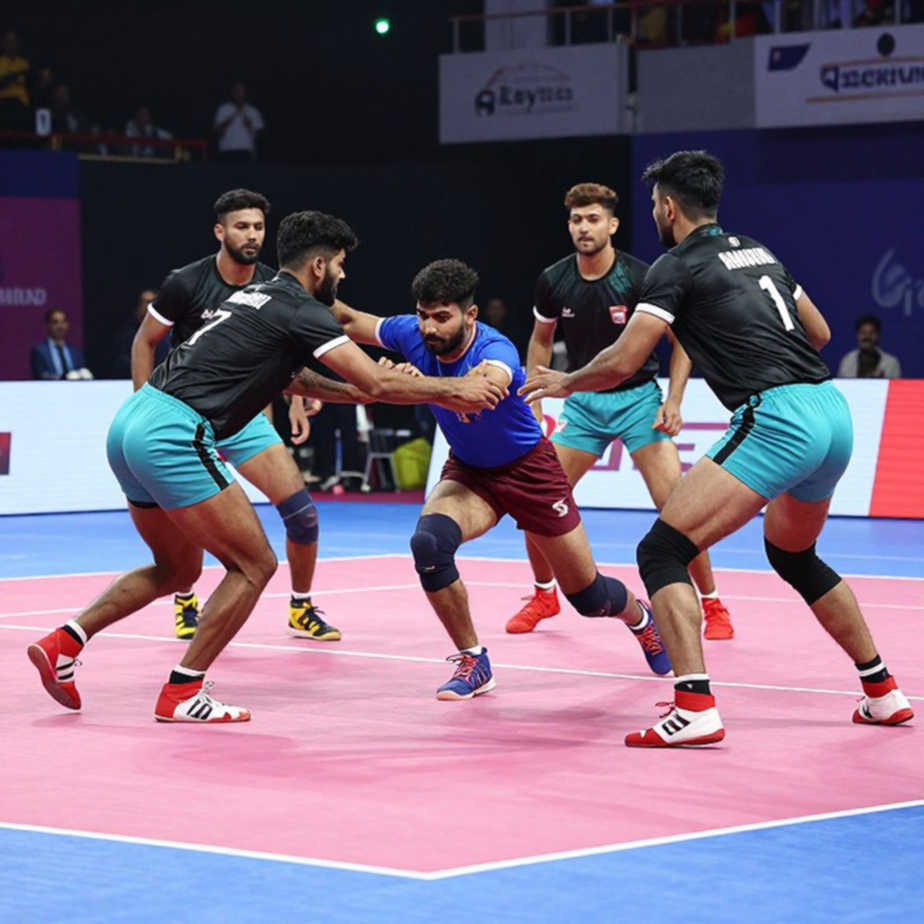
Likewise, it cannot be confirmed or ruled out that India's attack depends on a single raider, because player-level raid-point data does not exist. There is also no information on bench depth, rotation or the all-rounder role.
Nigeria: not just a defeat, a structural gap
17 and 18 points — this is not a bad day, it is a difference in tier. And it also shows how thin the competition in this championship is.
The scorelines trace a clear three-tier structure: tier one — India; tier two — England, Tanzania, Malaysia, Uganda; tier three — Nigeria. The 49-50 point margins against Nigeria define the floor of that third tier.
This is not proof of India's greatness; it is proof of the field's hollowness.
The biggest fact: Iran are not here
The single most important structural fact in this report is that Iran is not part of this tournament. Iran is the one nation that has genuinely beaten India at the top level — the 2026 Asian Games men's gold is the proof. Global kabaddi remains bipolar: India and Iran.
Without Iran, India's 'three wins in a row' are wins over tier-2 and tier-3 opposition, and they flatter India's apparent dominance. A reader relying solely on this article will overestimate India's margin over the world. Iran is not a Commonwealth member, so it is structurally excluded — that is not a fault of the tournament, it is a limit of the branding.
Note also that Pakistan and Bangladesh, both with deep kabaddi traditions (Pakistan especially in Circle Style), do not appear in this field — the source lists only six teams. If they are indeed absent, the field becomes even thinner.
'Commonwealth' branding: broad reach, shallow depth
Kabaddi is not part of the Commonwealth Games programme. This championship does not plug into the Commonwealth Games Federation's schedule. 'Commonwealth' here is a framing device, not a status. The branding positions kabaddi as a 'shared' sport of the Anglophone world, extending reach into Africa and Southeast Asia — it is a soft-power project, with India as the author.
Nigeria, Tanzania and Uganda's participation is development-stage, not competitive. Their presence signals outreach, not depth. The 49-50 point margins show these teams are far from tier-2, let alone India.
India's advantage is structural — a rural akhada pipeline (Haryana, Maharashtra, Punjab, Uttar Pradesh, Tamil Nadu) plus the professional machinery of the Pro Kabaddi League. That is a talent-pipeline gap that tier-3 nations cannot close in the near term.
Business and media: streaming-led, low-weight event
The source article is essentially a 'LIVE streaming and telecast' guide. That is itself a commercial signal — distribution is streaming-led, meaning the broadcast-rights tier sits well below the PKL or the Asian Games.
There is no data on sponsorship value, rights fees or player salaries. This is not a PKL event, so no auction mechanism applies — 'auction premium' analysis belongs to PKL coverage, not here. Player compensation for national-team duty at such events is typically modest, but that is an inference, not evidence.
Governance: opacity, not scandal
The biggest institutional risk is that the organiser is not identified and it is unclear whether the event carries IKF sanctioning. Kabaddi has a history of parallel and disputed federations and events, so the question is not trivial. There is no information on anti-doping, athlete protection or referee/TV-review standards.
And this event does not advance kabaddi's Olympic case — criteria such as the number of participating countries, continental coverage and women's-game depth are not met here, because strong teams like Iran and Korea are absent.
What to watch
In India vs Nigeria the question is not who wins but by how much — and that will be the best proxy for the sharpness of India's attack. If India do not blow Nigeria away by 60-plus, questions about attacking intensity will follow.
The real test will come against England, the only side here to have posted a big score. Whether a knockout stage exists is not stated in the source.
Conclusion
There are three wins on record; there is no dominance. India's defence is good, the attack is adequate, and captain Surjeet Singh's individual contribution is uncertain for want of data. The real value of this championship lies not in its competition but in the 'reach' of kabaddi's internationalisation — broad, but shallow. And until a team like Iran is on the mat, every Indian victory will remain half an answer to an unfinished question.