
Kabaddi's Second Life: From Mud Akhadas to Broadcast Graphics
कबड्डी दक्षिण एशिया का पारंपरिक टीम खेल है जिसमें सात-सात खिलाड़ियों की दो टीमें होती हैं और रेडर को एक ही साँस में लगातार 'कबड्डी' बोलते हुए 30 सेकंड के भीतर विपक्षी क्षेत्र से अंक लेकर लौटना होता है। यह 1990 बीजिंग एशियाई खेलों में पुरुष और 2010 ग्वांगझू में महिला वर्ग के रूप में आधिकारिक पदक खेल बना। भारतीय पुरुष टीम ने 1990 से 2018 तक लगातार आठ एशियाई खेलों में स्वर्ण जीता; 2023 हांगझू में ईरान ने फाइनल में भारत को हराकर यह क्रम तोड़ा। 2014 में शुरू प्रो कबड्डी लीग (मशाल स्पोर्ट्स और स्टार इंडिया) ने मैट-आधारित खेल, फ्रेंचाइज़ी मॉडल, नीलामी और टेलीविज़न-केंद्रित प्रसारण के ज़रिए खेल को व्यावसायिक रूप दिया। लीग में पुरुषों की 12 फ्रेंचाइज़ी हैं; स्थायी महिला लीग अभी नहीं है, केवल प्रदर्शनी मैच हुए हैं। प्रमुख खिलाड़ियों में परदीप नरवाल ('डुबकी किंग'), पवन सहरावत ('हाई-फ्लायर'), नवीन कुमार, फजल अत्राचली, अनूप कुमार, दीपक निवास हूडा और अजय ठाकुर शामिल हैं। मुख्य चुनौतियाँ: खिलाड़ी-कल्याण और चोट-प्रबंधन, सट्टेबाजी-विरोधी निगरानी, महिला लीग का अभाव, और ग्रामीण स्तर पर वैज्ञानिक प्रशिक्षण की कमी।
There are two scenes of the same sport, and both are real. One is a village akhada in northern India — dry mud, lines drawn with lime, bare feet, and a boy holding his breath while chanting 'kabaddi, kabaddi' as he throws himself into a wall of seven defenders. The other is an air-conditioned indoor stadium — jerseys bright against a blue mat, six cameras, slow-motion replays, and that same thirty-second countdown ticking on the screen. The rules are identical in both places. The physical pressure is identical. The difference is only the stake: in the first scene it is a village's honour, in the second it is a franchise worth crores and a prime-time broadcast slot.
The clearest way to understand kabaddi is to read it first as a rule system and then as an industry. Its distinctiveness is buried in the rules; its story is in what changed around them.
The architecture of thirty seconds
The court is 13 metres long and 10 metres wide, divided into two halves, seven players per side. The attacker — the raider — crosses into opposition territory, touches one or more defenders, and must return across his own line. If he returns, his team scores the number of defenders he touched, and those defenders are out. If they stop him, the points go the other way. That is a simple transaction, but it sits on one condition that separates this sport from nearly everything else.
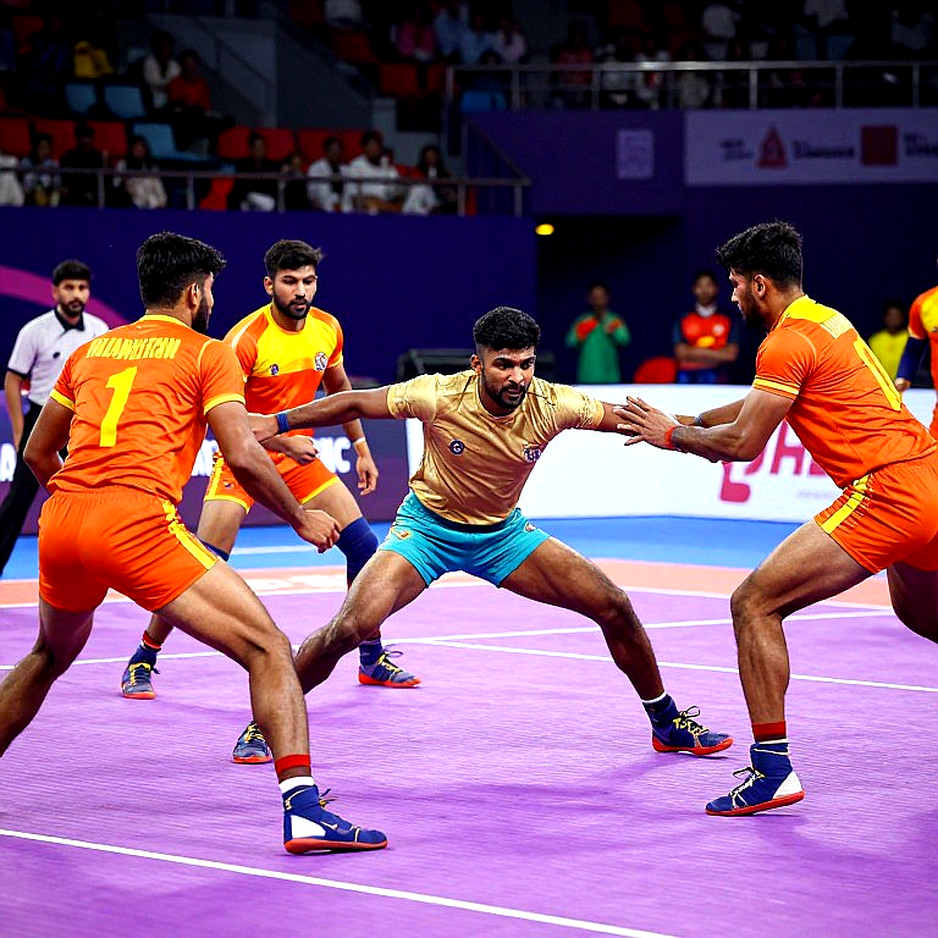
The raider must chant 'kabaddi' continuously, in a single breath, from the moment he enters until he returns. The instant he stops, breathes, or breaks the word, he has violated the 'cant' and is out. The most decisive moment in the sport is therefore the moment when a player's lungs are emptying and his brain is fighting oxygen debt. Kabaddi may be the only popular team sport that has written respiratory capacity directly into its rulebook. That is not technique; it is physiology — and it is the core identity of the game.
Around this sit layers of strategy. The lobbies on either flank let a raider pass without scoring and cannot be entered by defenders chasing him. The bonus line offers a low-reward, high-risk point for crossing without a touch. A tackle made with three or fewer defenders earns a super tackle and an extra point. And when all seven players of a side are out, an all out grants the opposition two points and a full revival.
The cumulative effect is that kabaddi is never safe. As soon as three or four of seven players are out, the defensive structure begins to collapse, and a collapsing structure invites aggression. That is why the last two minutes are the most dangerous: the trailing side is forced into risk, and the leading side must protect its defence. This arithmetic is denser than cricket's death overs or football's extra time, because the score can shift every thirty seconds.
From akhada to epic
There is no definitive proof of kabaddi's age, but it is clearly centuries old across South Asian rural society. In India it is often linked to Abhimanyu in the Mahabharata — entering the chakravyuh alone, and escaping the trap. The metaphor survives because the core experience of the sport is exactly that: one person, surrounded, with a single chance.
The sport has many names, and each is evidence of a distinct regional culture: ha-du-du in Bengal, hu-tu-tu in Maharashtra, chedugudu in Andhra Pradesh, kabaddi in Tamil Nadu and the north. These were not merely linguistic differences; several traditions also differed in rules. Standardisation came when the All India Kabaddi Federation was founded in 2026 and the rules were codified. That was the moment kabaddi moved from folk game to organised sport.
International expansion was slow but directional. Bangladesh grants it national-sport status; Nepal, Sri Lanka, Thailand, Japan, South Korea and Iran built organised structures. Iran's rise is the most interesting turn in this story.
The dates matter for the Asian Games: men's kabaddi became a medal sport at Beijing 2026, and women's kabaddi was added at Guangzhou 2026. Those two moments gave the sport a permanent stage beyond national borders — a stage that returned every four years, for which states had to fund programmes, and because of which training centres stayed open.
India's long dominance and its end
From 2026 to 2026, the Indian men's team did not let the Asian Games gold leave. Eight consecutive editions is an extraordinary record in any team sport. It rested on aggressive raiding combined with disciplined defence, and opponents rarely had the depth to absorb seven players rotating in rhythm.
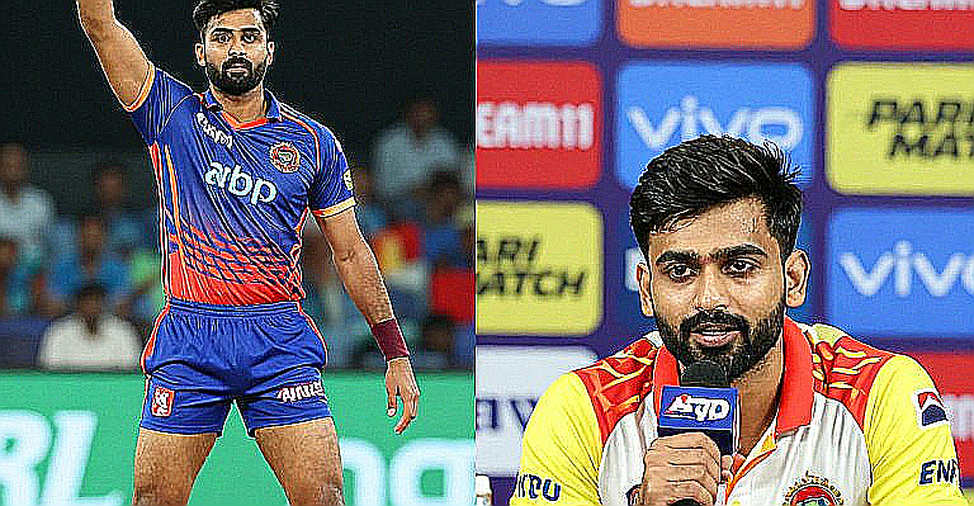
At Hangzhou 2026, that run ended. In the men's final, Iran beat India to take gold — the first time India had lost the Asian Games kabaddi title. It was not the result of one match; it was the visible part of a fifteen-year process.
Iran adopted kabaddi differently. It was treated as a physical and tactical sport rather than a cultural inheritance. The result was an early emphasis on defensive structure, physical strength and tackling technique. Players like Fazel Atrachali became symbols of that school — a defender who reads a raider's momentum, waits for the loss of balance, and brings him down. India won for years through raiding depth, but against a side built to shut the raid down, that depth carried less weight.
The broader lesson is that a nation's dominance in a sport is often a marker of that sport's international competitiveness, not of the nation's superiority. The more countries train systematically, the more the dominance erodes. In kabaddi that process is now visible.
2026: the year the sport changed
If the Asian Games gave kabaddi international legitimacy, the Pro Kabaddi League gave it a market. Launched in 2026 through a partnership between Mashal Sports and Star India, the league was built on the IPL franchise model — city-based teams, player auctions, a schedule designed for television, and heavy investment in broadcast.
Eight teams in the first season, later twelve. Jaipur Pink Panthers, U Mumba, Patna Pirates, Bengaluru Bulls, Dabang Delhi, Puneri Paltan, Telugu Titans, Tamil Thalaivas, Bengal Warriors, Gujarat Giants, Haryana Steelers and UP Yoddhas are now a permanent part of India's domestic sporting landscape. Ownership sits with film industry figures, media companies and corporate groups — itself a signal that the league was treated as part of the entertainment economy, not only as sport.
The biggest change was technical: the mat replaced mud. The mat made the game faster, cleaner and far more camera-friendly. The nature of knee and elbow injuries shifted, friction dropped, and pace increased. Broadcast technology followed — multi-camera coverage, slow motion, graphics showing raid timers and scores, and microphones on players that carry the sound of contact into living rooms.
This is where kabaddi solved its biggest problem. The sport's core difficulty for a viewer was legibility: who went out, who touched whom, when the cant broke. Broadcast fixed that. Replay removed doubt, graphics showed the arithmetic, commentary built the narrative. The league did not change the sport; it changed how the sport is read.
The economy of heroes
A league needs stars, and kabaddi already had them — they simply had no stage. The PKL gave them names, faces and a market.
Pardeep Narwal is called the 'Dubki King', and the nickname is a precise description of his technique. The dubki is a move in which the raider slips between a defender's legs, emerges behind him, and returns with the point. It is high-risk: mistimed, it lands the raider straight in the trap. Narwal repeated it often enough and cleanly enough to be counted among the league's most successful raiders, and his association with Patna Pirates became part of the team's identity.
Pawan Sehrawat is known as the 'Hi-Flyer' for his vertical leap. His game is pure explosion: speed, height, and the ability to clear a defender. Naveen Kumar represents a different school — low noise, high consistency. His value is accumulation without drama, and his performances for Dabang Delhi are a reminder that in a league, reliability is itself a star quality.
On the defensive side, captains like Anup Kumar and Deepak Niwas Hooda raised the level of team-building and on-court decision-making. Anup Kumar became the face of U Mumba and later moved into coaching and management, showing that the league created post-playing pathways. Ajay Thakur anchored India's attack for years. And from Iran, Fazel Atrachali proved the league was not only a platform for Indian players — a foreign defender could become the face of a franchise.
These names carry economic weight. The auction made player prices public, and that transparency was itself a change: previously there was no public benchmark for the income of a state-level kabaddi player. The league created a market in which talent had a price, and that price generated demand for training in villages and small towns.
But where is the other half?
An uncomfortable question must not be dodged. Women's kabaddi has been part of the Asian Games since 2026, and the Indian women's team has performed strongly on that stage. State-level traditions are not weak either. Yet when it comes to a domestic professional league, that platform has so far remained male-only.
Organisers have staged women's exhibition matches from time to time, but a full women's league has not yet become permanent. The effect is direct: a male player has a route through the league to income, fame and career extension; a female player has a narrower path built around international medals and government employment. This gap is not only about fairness — it is about market. Without a women's league, investment, training and audience all stay compressed.
Demand for change is now coming from inside. Women players and former players have publicly raised the need for a separate league, and the debate centres on whether it should be tied to the existing men's league or stand alone. Each carries risk — tying it shares broadcast and sponsorship but risks divided attention; separating it builds identity but raises upfront costs.
Iran, Bangladesh and a shifting geography
International kabaddi has historically been South Asian, but the base is slowly widening. Iran is the clearest example but not the only one. Bangladesh treats it as a national sport with serious domestic competition. Nepal, Sri Lanka and Thailand have organised structures. Japan and South Korea have a small but durable presence.
One consequence is that no match is as safe for India as it once was. That is good news for the sport and hard news for the Indian team. Historically, one side's dominance slows a sport's global expansion, because audiences want uncertainty. Iran's win gave kabaddi a storyline it did not previously have: will India come back? That question is useful to the market, even if it is uncomfortable for players.
Is the economic model sustainable?
The PKL's biggest achievement is that it built a domestic league in India that consistently draws television audiences, at least among non-cricket sports. Comparisons with the IPL are half-true: on scale, revenue and global reach the IPL is far ahead. The kabaddi league's strength is elsewhere — high visual intensity at low cost. A match finishes inside forty minutes, something happens every thirty seconds, and a viewer needs no deep technical knowledge to follow it. For television, that is an ideal product.
Three questions determine durability.
First, player welfare. Kabaddi is heavy on the body: knees, ankles, shoulders, back. A raider absorbs dozens of collisions per match. Careers are short, and post-league security remains uneven. Some franchises do better than others. A universal medical and pension framework is still a demand, not a reality.
Second, governance and integrity. As money grows, so does the risk of betting and match-fixing. No sport is fully immune, and kabaddi must keep its monitoring strong — a player grievance process, anti-betting surveillance, and transparent disciplinary action. Trust is the capital the league is built on.
Third, the base of the pyramid. The league needs stars, and stars come from akhadas. Haryana, Uttar Pradesh, Maharashtra, Tamil Nadu, Karnataka and Andhra Pradesh have deep roots, but the structure there is still largely informal — village grounds, local tournaments, family tradition. Khelo India and state schemes have formalised some of it, but coaching quality, injury management and scientific training remain concentrated in cities. If the league only picks up players who are already made, the talent pool will thin within a decade.
Rules and technology: slow, continuous change
Kabaddi has changed its rules carefully. Video review made raid and tackle decisions more trustworthy, though it broke the flow of the game. Rules like the do-or-die raid forced aggression — after a set period a team cannot return from a raid without points, which limits purely defensive play. The change was viewer-friendly, but it cut off a whole branch of strategy.
The mat was a change of surface, but it changed the sport's nature. On mud, a raider's speed was limited, feet slipped, and contact was slower. On the mat, pace increased, moves like the dubki became possible, and raid timing became more efficient. Many older players recall the muscular challenge of the mud game — falling and rising were separate skills. The debate over whether the mat improved the sport or removed a physical dimension has not closed.
Asian Games, World Cup and the Olympic question
The Asian Games are central to kabaddi's international structure, because a medal there carries political and financial weight. A kabaddi World Cup has been held periodically, with India dominant, and the sport also features in the South Asian Games and Asian Indoor Games. But the biggest question remains unanswered: will kabaddi ever become an Olympic sport?
There are two sides to it. Technically, Olympic inclusion requires a minimum level of global participation, a strong governance framework and a clear anti-doping system. Kabaddi has advanced on some fronts and lags on others. Politically, the Olympic programme has limited room and not every sport gets in. India's 2036 hosting bid has revived discussion of kabaddi's inclusion, but that remains a discussion, not a decision.
Meanwhile, kabaddi's real growth is in Asian and domestic markets, and that is its actual foundation. No sport grows while waiting for the Olympics; it grows from its domestic base, and kabaddi has done that work over the past decade.
The cultural question
One point is often missed: kabaddi's appeal is not only competition but social texture. It comes from regions where the playing field and public life are connected. The village akhada was not merely a venue; it was a centre of physical discipline, identity and local prestige. When the sport moved into stadiums, it lost that collectivity and gained national visibility.
That trade is not entirely beneficial. Local competition culture has weakened, urban academies are replacing village grounds, and the sport's economic door opens mainly to those who find the right guidance early. On the other hand, the league showed families a path where previously there was no example of sport as a career.
The road ahead
Kabaddi today is in a rare position: a working domestic league, an international calendar, a clear rule system and a product that works on television. Very few sports have that combination.
The next decade will be decided by three things. First, a women's league — permanent, not exhibition — which would double the talent base and strengthen the sport's social legitimacy. Second, an institutional player-welfare framework: injury management, insurance, pensions and post-retirement pathways. Third, the base of the pyramid: coaching quality at school and block level, so that talent does not come only from states with a traditional kabaddi culture.
And a fourth, less discussed but essential front: competitive balance. A league lives only if any team can win in any season. If three or four franchises share the trophy, interest will decline. Auctions, retention rules and youth opportunities are the tools of that balance.
The most interesting part of kabaddi's story is that it did not remake itself — it re-read itself. The mud game did not change; the way it is watched changed. A sport that once drew a single village crowd now sits on a stage where its time, its points and its mistakes are all recorded. That is progress, and it is also risk — because a sport that is watched is a sport that is expected of.
In some akhada in northern India, a boy is still holding his breath and chanting 'kabaddi, kabaddi'. He does not know that his breath will one day become a graphic on a screen. But the future of the sport depends on whether that boy can travel from there to here — and stay safe after he arrives.